

NYC
Making False Statements
Lawyers
Why an NYC False Statements Lawyer Matters From the Moment You're Accused
A single signed page can turn into a criminal case. Maybe you signed a criminal complaint, filled out a police report, or swore in an affidavit to something a prosecutor now says is untrue. That accusation alone doesn’t make you guilty, and what happens next depends heavily on what you say and do before you ever stand before a judge.
An NYC false statements lawyer at Law Offices of Robert Tsigler, PLLC looks closely at the exact wording you signed and who asked you to sign it. The lawyer also checks whether prosecutors can prove you knew it was false when you signed it.
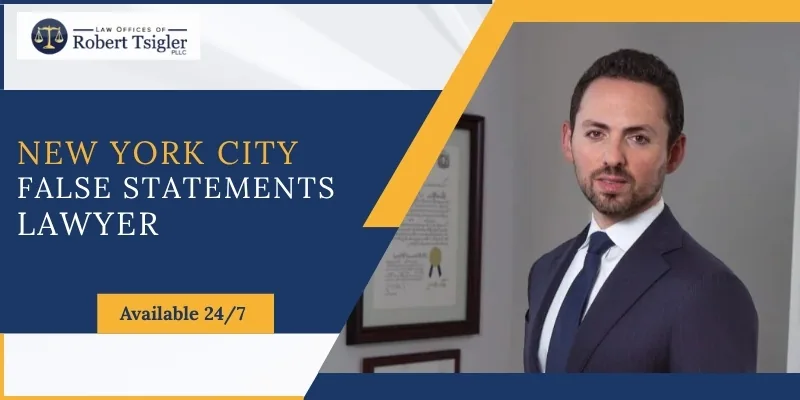
Robert Tsigler is admitted to the New York State Bar, the New Jersey State Bar, the Board of Immigration Appeals, and several federal courts. These include the U.S. District Courts for the Eastern, Southern, and Western Districts of New York.
Under New York Penal Law 210.45, making a false written statement can be punishable. False written statements are a related offense under New York’s perjury laws. Perjury is the criminal offense that occurs when a person lies under oath.
Most people think of perjury as the crime that occurs when a witness lies during a trial. But making false written statements in criminal complaints or sworn affidavits can also be charged as perjury.
New York’s criminal code outlines multiple perjury offenses. Government officials, law enforcement officers, and private citizens can all commit perjury. If you have been accused of making a false written statement, the potential charge you face depends on the circumstances surrounding the statement.
Penal Law 210.45 applies when the false statement is in writing. Most commonly, this occurs when a person signs a false statement when filing a criminal complaint.
Examples of Punishable False Written Statement Charges in New York
In People v. Ackermann, the defendant was a police officer named Michael Ackermann. He was charged with several crimes, including making a punishable false written statement. He had signed a false criminal complaint.
The complaint in question alleged that a New York Times photographer named Robert Stolarik had resisted arrest, obstructed governmental administration, and committed other related crimes. Ackermann stated that Stolarik impeded the arrest by approaching him with a camera and repeatedly firing a bright flash.
At the time, the photographer was arrested. Later, the evidence showed that the camera Stolarik was using didn’t have any built-in flash capabilities. Stolarik also had no external flash attachments when he was arrested.
In People v. Shutter, the defendant was a woman named Lisa Shutter. She was convicted of having made a punishable false written statement. The statement in question was a false complaint alleging that a police officer had inappropriately touched her in the middle of a traffic stop.
In People v. Lowin, defendant Sarah Lowin received a conviction of having made a punishable false statement following the towing of two vehicles from her property. The vehicles belonged to another individual. The police asked her about the vehicles, and she stated that she was unsure where they had gone.
Later, a tow truck driver witnessed that the vehicles had been towed upon Lowin’s request.
Defenses an NYC False Statements Lawyer Can Raise
The prosecution must prove that you made the false statement intentionally and willingly. This means that you must have known you were making a false statement. If the false statement occurred because you remembered facts inaccurately or made a mistake, you would not meet the “knowingly” clause of the law.
Therefore, you would not have committed this crime.
In another defense, you can be exonerated from making a false written statement if you can prove that the statement was true. If you provide evidence that your statement was true, you wouldn’t be found guilty of this particular charge.
A third angle focuses on the document itself. Penal Law 210.45 applies only to a written instrument that includes a specific, legally authorized notice warning that false statements are punishable.
If the form you signed lacked that notice, or if the notice wasn’t legally authorized, the charge may not hold up as written. Reviewing the exact paperwork, not just what you told police, often marks the start of a defense against this charge.
What a Conviction Could Cost You, and When It Can Become a Felony
When you are convicted of having made a false written statement, you have committed a class A misdemeanor. Class A misdemeanors are the most serious misdemeanor class. If you are convicted, the maximum sentence is 364 days in jail, three years of probation, and a fine.
New York prosecutors generally have two years from the date of the statement to file a misdemeanor charge like this one, though certain circumstances can pause that clock.
The charge can also get more serious. Prosecutors can instead pursue a felony charge when three things are true. The document is one the law requires to be sworn. The statement was made to mislead a public servant doing an official job, and it was material to the matter at hand. That charge is Penal Law 210.40, making an apparently sworn false statement in the first degree.
It is a class E felony, carrying up to 4 years in prison rather than the lesser penalties tied to a misdemeanor. Whether a case stays a misdemeanor or escalates to a felony often depends on the document’s specific wording and the intent prosecutors believe it shows.
To convict, the prosecutor must have sufficient evidence to prove you knowingly and willingly made a false statement. It helps to speak with a defense lawyer as early in the process as possible. The specific document and the circumstances around it often decide whether a charge can be reduced, dismissed, or taken to trial.
This information reflects New York law as of October 2026.
How a False Statement Case Moves Through Manhattan, Brooklyn, and Queens Courts
Where your case lands depends on where the statement was made or where the complaint was filed. A false statement tied to a Manhattan arrest is typically arraigned at the Manhattan Criminal Court, part of the First Judicial District. Cases originating in Brooklyn or Queens move through their own borough criminal courts.
The charge itself does not change from one borough to another, but local practices around arraignment scheduling and case handling do vary.
Robert Tsigler began his legal career interning at the Kings County District Attorney’s Office before founding the firm, giving him a view of how prosecutors in Brooklyn build these cases from the inside.
At the Law Offices of Robert Tsigler, PLLC, cases get reviewed through an internal roundtable where attorneys discuss strategy together rather than one lawyer working a false statements case alone. The firm’s team is reachable around the clock once you become a client.
Robert Tsigler also holds an Avvo 10.0 Superb rating and a Martindale-Hubbell Client Champion designation, and has been selected to the Super Lawyers Rising Stars list.
Frequently Asked Questions
Which court will hear my false statement case if I was arrested in Manhattan?
Most Manhattan arrests for a false written statement charge are arraigned at the Manhattan Criminal Court on Centre Street, part of the First Judicial District. If you were arrested in Brooklyn or Queens instead, you’d be arraigned in that borough’s criminal court rather than in Manhattan.
Can a false statement charge be resolved without going to trial?
Many misdemeanor cases resolve through negotiation, a motion to dismiss, or a reduced plea before trial. Whether that is realistic in your case depends on the strength of the evidence and whether the document itself meets every element of the charge.
Does a false statement charge affect my immigration status?
A conviction for making a false written statement can have immigration consequences for non-citizens, since certain dishonesty-related crimes can affect a pending application or status. Anyone facing this charge who is not a U.S. citizen should raise that concern with their lawyer right away.
What does it cost to hire a false statements lawyer in NYC?
Fees vary based on the case’s complexity and whether it stays a misdemeanor or risks becoming a felony. The Law Offices of Robert Tsigler, PLLC offers reasonable fees and payment plans so cost is not the reason someone goes without a defense.
Can I still be charged if I later corrected my statement?
Correcting a statement after the fact does not automatically erase the original false statement, but it can matter to how a prosecutor or judge views your intent. This is a detail worth discussing with a lawyer rather than assuming it resolves the charge on its own.
Questions about a specific complaint, affidavit, or police report are best answered by reviewing the actual document, so reach out before assuming how a charge like this will play out.
Speak With an NYC False Statements Lawyer Before You Say Anything Else
A false statement charge can move quickly from a signed complaint to a courtroom, and what you say in the meantime can shape the entire case. Our NYC false statements lawyers at the Law Offices of Robert Tsigler, PLLC review the document at the center of your case and work to protect you at every stage, from arraignment through resolution.
Contact us today to talk through what you’re facing and what comes next.

NYC
Practice Areas
We Set the Bar Others Strive to Reach







DON'T
DELAY
discuss your case right away.
Schedule A Consult
"*" indicates required fields