



USCIS Says It Will Grant “Adjustment of Status” Only in “Extraordinary Circumstances”
If this is truly a policy change, it will be unlawful. Denials should be appealed and immigration court may ironically be the better option.
Bottom Line: On May 22, 2026, USCIS announced it would grant green cards only in “extraordinary circumstances” – a standard it invented and did not define. If enforced as stated, the rule would upend decades of immigration practice and affect a wide range of applicants, including people here on temporary visas and immediate relatives of U.S. citizens. We believe the new rule, if implemented, is legally deficient and unlikely to survive court scrutiny. In the meantime, if you have a pending or planned adjustment of status application, you should speak with an attorney. Call us at (718) 878-3781.
On Friday, May 22, 2026, the United States Citizenship and Immigration Services (USCIS) released a memorandum and press release announcing changes to how adjustment of status applications will be processed. The headline alarmed many, including attorneys at this office. A closer look, however, suggests the news may be more smoke than fire.
The memo and press release make “extraordinary” claims.
Adjustment of status (“AOS”) applications are requests for lawful permanent residence – what most people call “getting a green card.” One may apply for AOS after being granted refugee status, asylum, an employment-based petition, a family-based petition, or through several other qualifying categories.
The new memo frames AOS as “extraordinary” when compared with applying for permanent residence through a consulate abroad: “The nature of adjustment of status relief remains best understood as extraordinary because it permits the alien applicant to avoid the prescribed, ordinary consular visa process to obtain lawful permanent residence without leaving the United States.” Given this framing, the memo reemphasizes that officers should weigh all relevant factors when deciding whether to grant an application.
Officers have long had this discretionary authority. The memo simply reminds them of the factors relevant to that analysis – for example, that “[a]n alien’s failure to comply with the conditions of their nonimmigrant admission or parole and an alien’s failure to depart as expected are highly relevant to this analysis.”
The press release went further, asserting that “an alien who is in the U.S. temporarily and wants a Green Card must return to their home country to apply, except in extraordinary circumstances.” What constitutes “extraordinary circumstances” was left unexplained, but the remedy was explicit: AOS applicants should leave the United States and pursue permanent residence through the consular process.
The suggestion that people on temporary status or who have overstayed generally cannot adjust status has understandably caused significant concern. If enforced as stated, the rule would represent a sea change for immigration practice and would directly affect a substantial portion of our clients.
The memo and press release are legally deficient.
If USCIS begins challenging or denying applicants on this basis, it will almost certainly violate the law. Several reasons explain why courts are unlikely to let this rule stand. (If you are not an attorney, feel free to skip to the next section and take my word for it.)
First, the “extraordinary circumstances” standard was invented by a USCIS spokesperson quoted in the press release. The headline repeated it. But it appears in no statute, regulation, or court decision. It does not even appear in the memo the press release purports to introduce.
Second, the memo’s characterization of AOS as “extraordinary” is not new. Pages 1-2 and footnotes 2-5 of the memo cite extensively to cases making essentially the same point, most tracing back to a 1974 decision by the Board of Immigration Appeals, the highest immigration tribunal within the Executive Branch (citations omitted and emphasis added):
Adjustment of status . . . was not designed to supersede the regular consular visa-issuing processes or to be granted in non-meritorious cases. An applicant who meets the objective prerequisites for adjustment of status is in no way entitled to that relief. That relief is extraordinary inasmuch as it dispenses with ordinary immigration procedures. We therefore . . . affirm, that the extraordinary discretionary relief provided in section 245 of the Act can only be granted in meritorious cases, and that the burden is always upon the alien to establish that his application for that relief merits favorable consideration.
Nothing in that passage, or a similar passage from a 1965 case supporting other listed authorities in the memo, is surprising except the word “extraordinary.” The rest – that AOS should be granted only in meritorious cases, that applicants bear the burden of proof, that AOS is not an entitlement – reflects standard practice. The word “extraordinary” in this context means only that AOS is an exception to the ordinary process for those who would otherwise apply from abroad. Where an applicant commits fraud to evade a readily available consular process (as alleged in both the 1965 and 1974 cases), AOS is extraordinary in that precise sense. The word does not render every temporary visitor who files for AOS an improper applicant.
AOS is, in general, a perfectly ordinary process because it is codified in statute: Immigration and Nationality Act § 245, 8 U.S.C. § 1255, is titled “Adjustment of status of nonimmigrant to that of person admitted for permanent residence.” Congress first enacted this provision in 1952. Characterizing a pathway Congress has maintained for 74 years as “extraordinary,” and therefore presumptively disfavored, strains credulity.
Every practitioner knows that a non-meritorious case, or one where negative discretionary factors outweigh positive ones, should be denied. If the memo means anything beyond that settled principle, it is creating new law that contradicts Congress. The memo crosses that line when it states (emphasis added):
While aliens who were inspected and admitted or paroled may request adjustment of status, as a general matter the discretionary approval of such a request is extraordinary given Congress’s intent that aliens should depart once the purpose for which they sought parole or nonimmigrant admission from DHS has been accomplished.
This reasoning is flawed. That Congress intended temporary visitors to remain temporarily and also created a statutory pathway for them to remain permanently through AOS means AOS is not generally extraordinary for such applicants.
The text of INA § 245(c) confirms Congress’s intent. That subsection lists categories of aliens ineligible for AOS, including those who worked without authorization or fell out of lawful status. But Congress expressly carved out exceptions, including for immediate relatives of U.S. citizens, such as spouses, parents of adult citizens, and minor children. To penalize these applicants for overstaying – when Congress expressly exempted them from the § 245(c) bar – would itself be extraordinary. To go further and penalize applicants who have not even fallen out of status – those that aren’t even barred by §245(c) – is indefensible.
Congress also already penalized overstays without hobbling their AOS eligibility. Under INA § 212(a)(9)(B), aliens who overstay by more than 180 days and then depart face a three-year bar on returning or gaining permanent residence; those who overstay a year or more and then depart face a ten-year bar. Both penalties are triggered only upon departure. A basic rule of statutory interpretation – that expressing one remedy implies the exclusion of others – means Congress’s choice to punish overstays upon departure signals it did not intend to punish overstays in other ways.
In sum, Congress explicitly created an AOS pathway for temporary entrants, expressly limited that pathway in certain circumstances and not others, and established separate consequences for overstays. The selective use of the word “extraordinary” cannot nullify that statutory scheme. As another well-established rule holds, provisions should be interpreted in a way that renders them compatible rather than contradictory.
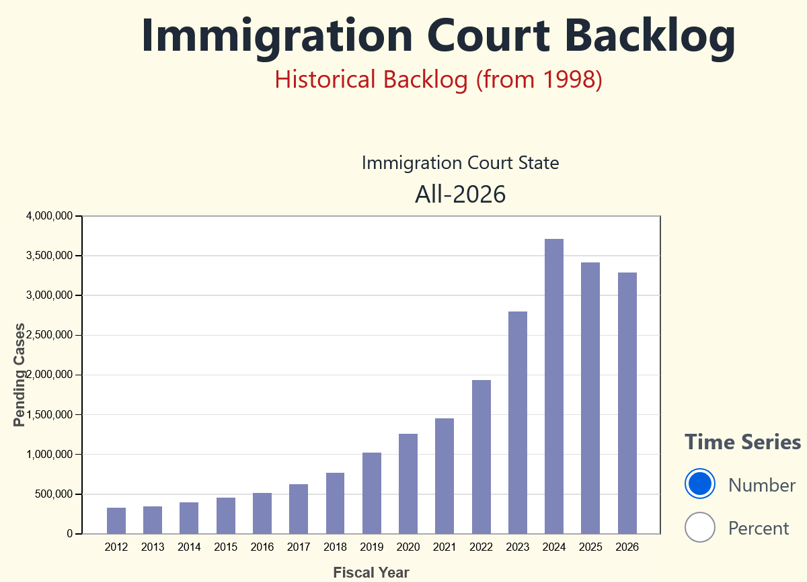
Finally, even if USCIS were inclined to press this rule, the practical consequences would almost certainly deter the courts. The New York Times recently reported that immigration judges who did not deny cases fast enough have been “purged,” and that “[l]ast year, as judges resolved claims more rapidly under Mr. Trump, the [immigration court] backlog fell for the first time in at least two decades.” That backlog still stands at nearly 3.3 million cases, with an average wait time of nearly 900 days (more than 2.4 years). Because overstays are not subject to the new mandatory detention rule that applies to unlawful entrants, they would likely remain out of custody – and non-detained cases are typically much slower to resolve. Routing a wave of AOS cases into an already-overwhelmed system would be difficult for any court to countenance.
The memo is unlikely to change anything.
If the novel element of the memo and press release (the “extraordinary” framing) is likely unlawful, and the familiar element (the reminder that AOS is discretionary) changes nothing, what will actually happen?
Probably nothing. In August 2025, two memos purported to make similar changes to immigration law and raised comparable concerns, including at this firm. The practical result was, at most, a greater emphasis on officer discretion in processing applications.
Still, anything is possible. Until officers reach a shared understanding of what the releases require – with or without court intervention – individual officers will implement them as they see fit. Some will likely take an impermissibly hard line, and they will likely apply the memo retroactively to pending applications, on the theory that the memo merely restates existing law.
If the rule change takes effect, or if individual officers act as though it has, attorneys should be prepared to appeal incorrect denials or refile. Prospective filers should consult an attorney about whether to file for AOS now.
What to do if the memo has real consequences.
If an officer applies heightened scrutiny and demands a showing of “extraordinary circumstances,” we would pursue two approaches.
First, we would submit a legal memorandum along the lines of the statutory analysis above, demonstrating that the officer is applying the wrong standard.
Second, we would work with clients to document that “extraordinary circumstances” are in fact present. David Bier, an immigration analyst at the Cato Institute, has identified the hardships that would follow from such a rule. Each of the following would serve as a compelling showing of extraordinary circumstances:
- Forcing green card applicants to leave will render many green card applicants ineligible because, when they leave the United States, they will trigger the 3- or 10-year bars on receiving an immigrant visa based on accrual of unlawful presence.
- It may cost them their jobs and, therefore, their sponsorship if visa delays prevent them from returning quickly (which is guaranteed to happen based on the flood of new applications).
- It will cause them to be subject to the Trump administration’s 75-country immigrant visa suspension and 40-country travel ban (92 total countries) – or half the immigrant visa flow.
- It will cause them to forfeit hundreds of millions [in the aggregate] in application fees.
- It will force them to apply at consulates where the doctrine of consular nonreviewability protects any denial from judicial review, and there is no administrative appeals process.
- When people are denied, if their underlying status has expired, they will be eligible for arrest and deportation – juicing ICE’s deportation machine.
Bier’s final point echoes a point above: that immigration courts, which would be flooded under this rule, are not bound by the USCIS memo or press release. Counterintuitively, a client who is denied by USCIS may fare better in immigration court, which remains legally obligated to grant adjustments of status that USCIS might now refuse. Extraordinary times call for extraordinary measures.
If you believe this policy may affect you, call (718) 878-3781 to schedule a consultation with one of our immigration attorneys.